
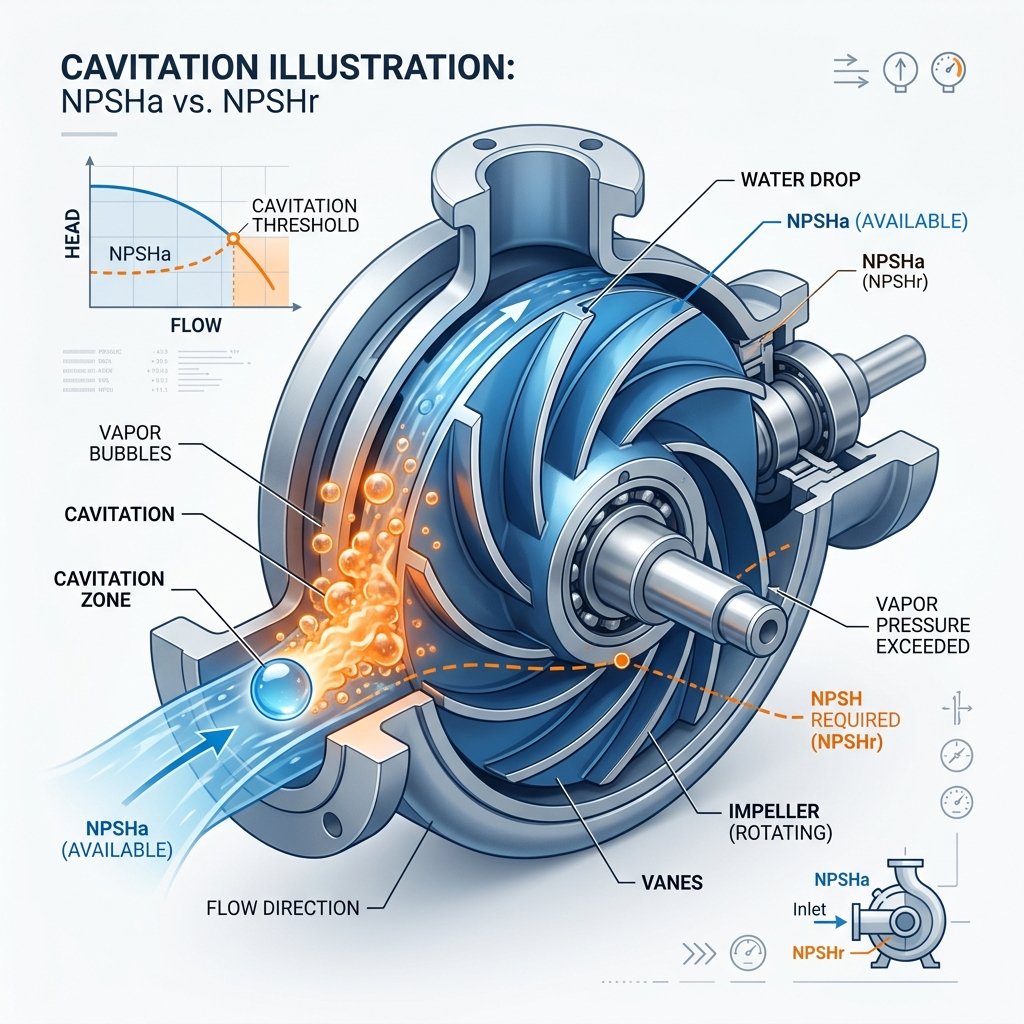
When dealing with industrial centrifugal pumps—especially those handling high-temperature fluids like boiler feedwater—understanding the difference between NPSHa vs NPSHr is the single most important factor in preventing catastrophic mechanical failure.
NPSH stands for Net Positive Suction Head. It is a measurement of the absolute pressure of the fluid at the pump's suction flange, minus the fluid's vapor pressure, expressed in terms of fluid height (meters or feet). If you fail to maintain adequate NPSH, the fluid will literally boil inside the pump impeller.
In this comprehensive technical guide, we will break down the exact definitions, the underlying thermodynamic physics of cavitation, and how to properly calculate safety margins in accordance with the API 610 (American Petroleum Institute) standard for centrifugal pumps.
If you want to skip the manual math, you can instantly run these checks using our free boiler feed pump calculation tool.
What is NPSHa (Available)?
NPSHa stands for Net Positive Suction Head Available. This is purely a function of your system's physical design. The pump manufacturer has no control over NPSHa; it is entirely determined by the mechanical engineer who designs the piping, the tanks, and the operating temperatures of the plant.
- P_absolute = Absolute pressure on the surface of the liquid (e.g., inside the deaerator)
- P_vapor = Vapor pressure of the liquid at its current operating temperature
- Z_static = Static elevation difference between the liquid level and the pump centerline
- H_friction = Pressure loss due to friction in the suction piping and strainers
The Deaerator Dilemma: In boiler feed systems, the water inside the deaerator is held exactly at saturation temperature to boil off dissolved oxygen. Because it is at saturation, the absolute pressure (P_absolute) and the vapor pressure (P_vapor) perfectly cancel each other out. Thus, for boiler feed pumps, the equation collapses significantly: NPSHa = Z_static - H_friction.
This means the only thing keeping the water liquid is gravity (the height of the deaerator above the pump). This is why feed water tanks are always mounted on towering steel platforms. For more information on how physical tank geometry affects this, see our Boiler Feed Water Tank Sizing Guide.
What is NPSHr (Required)?
NPSHr stands for Net Positive Suction Head Required. This is purely a function of the pump's internal geometry and impeller design. The system engineer has no control over NPSHr; it is determined through physical testing by the pump manufacturer on a test stand.
As fluid enters the eye of an impeller, it experiences a localized drop in pressure due to the sudden acceleration of the fluid. If the incoming fluid does not have enough baseline pressure (NPSHa) to survive this localized pressure drop, it will flash into vapor. NPSHr is defined as the exact amount of suction head required to prevent the pump from losing 3% of its Total Dynamic Head (TDH) due to vapor blockage.
A common misconception is that NPSHr represents the point where cavitation begins. In reality, cavitation has already begun before the 3% head drop occurs. This is why strict safety margins are legally enforced in industrial design.
The Destructive Physics of Cavitation
The golden rule of pump hydraulics is simple: NPSHa must always be greater than NPSHr.
When NPSHa falls below NPSHr, the localized pressure inside the impeller eye drops below the fluid's vapor pressure. The hot liquid instantly flashes into thousands of microscopic steam bubbles. As these bubbles travel further into the impeller, the pressure rapidly increases, forcing the bubbles to violently collapse (implode).
These implosions generate localized micro-jets of water traveling at supersonic speeds. When these micro-jets strike the metal surface of the impeller, they blow microscopic craters into the steel. Over time, this sounds like the pump is pumping gravel or marbles. Left unchecked, cavitation will:
- Shred the cast iron or stainless steel impeller into a sponge-like texture.
- Cause severe mechanical vibration, immediately destroying the mechanical seals.
- Wipe out the radial and thrust bearings of the motor.
- Result in a total loss of feedwater flow, causing the boiler to trip offline.
Calculating the Safety Margin (API 610)
Because NPSHr is tested under idealized laboratory conditions with cold water, installing a pump where NPSHa exactly equals NPSHr is incredibly dangerous. Process plants experience transient conditions (valves opening, sudden thermal shocks, strainer clogging) that momentarily reduce NPSHa.
The API 610 standard dictates that for heavy-duty industrial pumps, NPSHa must exceed NPSHr by a minimum safety margin of 1.0 meter (3.3 feet) or a ratio of 1.1:1, whichever is greater.
If your current system design violates this rule, you have only a few options to fix it:
- Increase NPSHa: Raise the physical elevation of the deaerator tank (increase Z_static).
- Increase NPSHa: Increase the diameter of the suction piping to reduce friction losses (reduce H_friction).
- Decrease NPSHr: Select a different pump with a larger impeller eye, or utilize a low-speed inducer.
Automate Your NPSHa Analysis
Manually cross-referencing steam tables to find precise vapor pressures at 140°C is prone to human error. A single mathematical mistake will result in a pump that destroys itself within weeks of commissioning.